
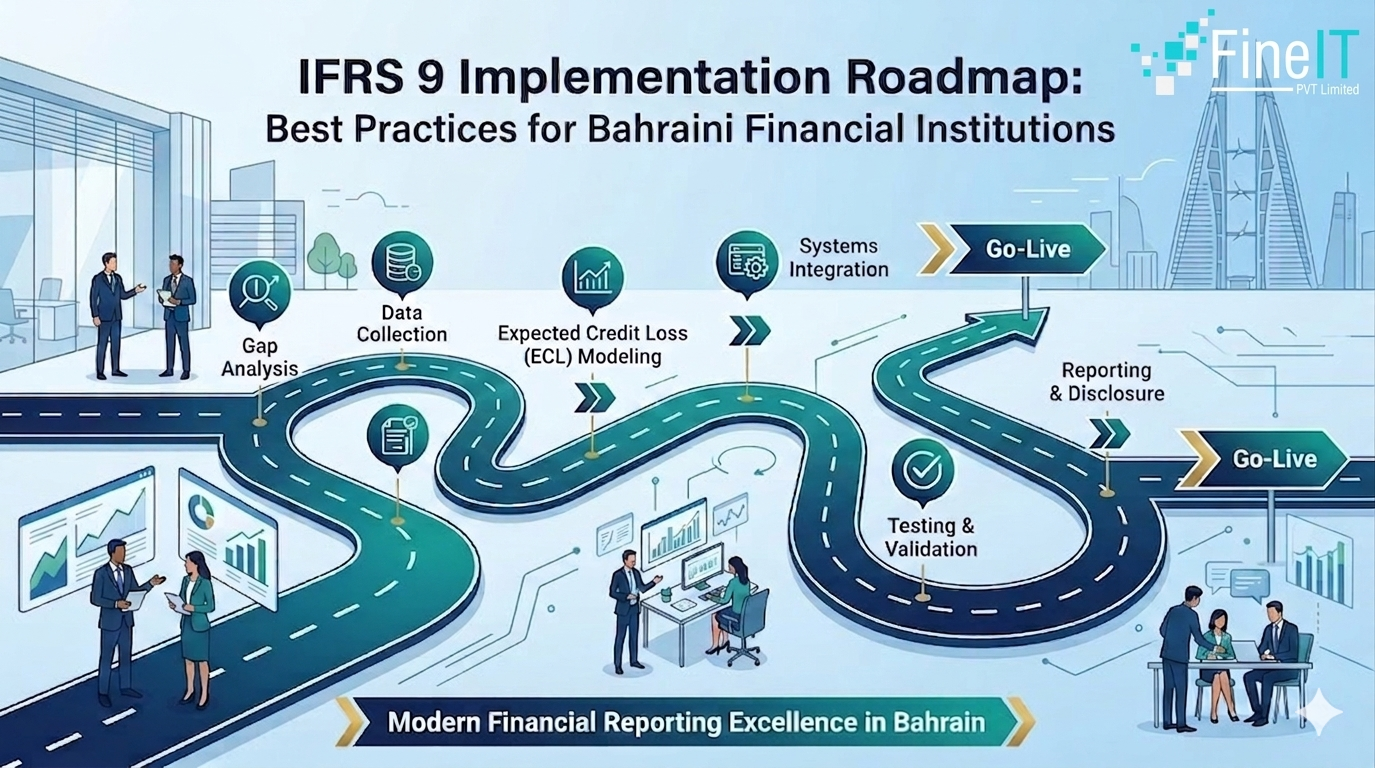
The implementation of IFRS 9 represents a fundamental shift from the previous “incurred-loss” model under IAS 39 to a forward-looking “Expected Credit Loss” (ECL) framework. For Bahraini financial institutions, which operate within a sophisticated environment balancing conventional and Islamic finance, this transition is critical for maintaining regulatory compliance with the Central Bank of Bahrain (CBB) and ensuring financial stability.
1. Governance and Strategic Planning
Effective implementation begins with high-level institutional commitment.
Steering Committees:
Institutions should establish executive-level oversight to manage the transition, allocate resources, and ensure coordination across finance, risk, and IT departments.
Regulatory Alignment:
As IFRS 9 is principle-based, banks must navigate the balance between flexibility and supervisory expectations. In Bahrain, compliance must align with the CBB’s established regulatory reporting frameworks and international Basel standards.
Islamic Finance Integration:
For Islamic banks, it is essential to harmonize IFRS 9 requirements with AAOIFI Shariah standards, ensuring that the operational mechanics of financial products remain compliant with both accounting and religious objectives.
2. Data Quality and Macroeconomic Modeling
The move to an ECL model requires moving beyond historical averages to incorporate predictive, forward-looking information.
Data Architecture:
Banks must invest in robust data governance to handle the granularity required for Probability of Default (PD), Loss Given Default (LGD), and Exposure at Default (EAD) parameters.
Macroeconomic Variables (MEVs):
Institutions are required to integrate macroeconomic forecasts such as GDP growth, unemployment rates, and interest rates into their credit loss estimates.
Scenario Analysis:
Given the uncertainty in regional markets, developing diverse economic scenarios is vital to mitigate the “cliff-effect” and reduce procyclicality.
3. ECL Methodology and Staging
IFRS 9 categorizes financial assets into three stages based on credit risk evolution:
Stage 1:
Assets with minimal credit risk; institutions must recognize 12-month ECL.
Stage 2:
Assets that have experienced a Significant Increase in Credit Risk (SICR); these require lifetime ECL calculations.
Stage 3:
Credit-impaired assets, which also require lifetime ECL provisions.
Model Validation:
Continuous back-testing and sensitivity analysis are essential to ensure that management judgments and statistical models remain accurate over time.
4. Best Practices for Operational Excellence
Automation:
Manual processes increase the risk of errors and management bias. Automating ECL computations helps ensure audit readiness and consistency.
Transparency and Disclosure:
Clear management commentary regarding modeling assumptions and management “overlays” is necessary to build investor and regulatory trust.
Proportionality:
Smaller institutions should adopt methodologies that reflect their size and risk profile, avoiding unnecessary over-complication while still meeting fundamental compliance standards.
Conclusion
The successful adoption of IFRS 9 in Bahrain is more than a technical accounting exercise; it is a strategic management imperative. By prioritizing robust data governance, integrating meaningful macroeconomic forecasts, and maintaining transparent communication with the CBB, financial institutions can effectively mitigate credit risk and navigate economic cycles. While the standard’s flexibility offers institutions room to tailor their approaches, it also places the responsibility on management to apply sound judgment, ensuring that their financial reporting remains both resilient and comparable across the regional banking sector.
FineIT simplifies IFRS 9 in Bahrain helping you stay compliant, reduce risk, and build smarter financial strategies. Start your transformation today.

Muzammal Rahim Khan is the CEO and Co-Founder of FineIT, bringing over 15 years of expertise in software development, implementation, and technical consulting across global markets including the U.S., U.K., Europe, Africa, and Asia. He has led the design and delivery of enterprise-grade solutions that modernize compliance, risk management, and financial reporting for banks and financial institutions. Under his leadership, FineIT has built flagship platforms such as Estimator9 (IFRS 9) and ContractHive (IFRS 16), empowering clients with automation, accuracy, and audit-ready confidence. Muzammal combines deep technical knowledge with strategic vision, driving innovation that bridges regulatory requirements with practical, scalable technology. His focus remains on building resilient, future-ready solutions that strengthen trust and efficiency in financial services.