
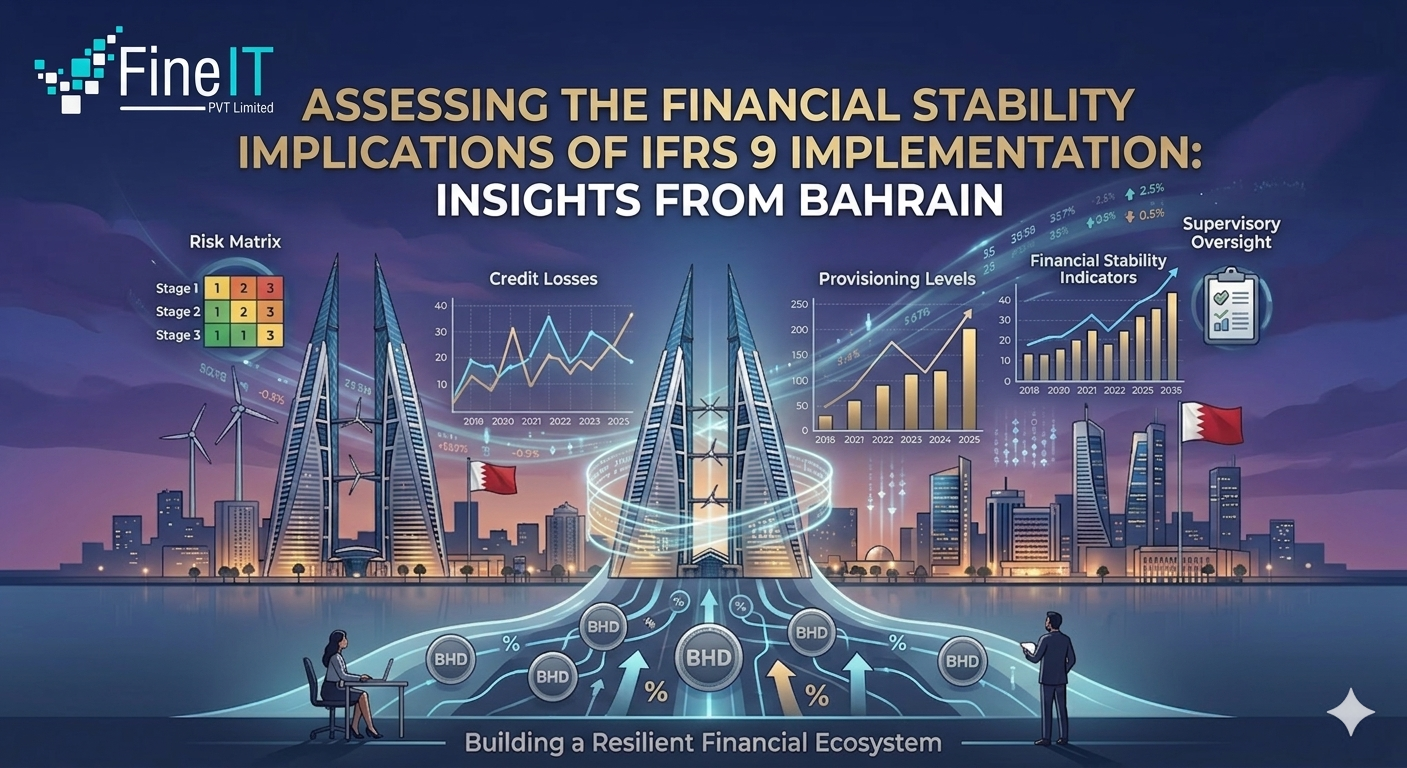
The transition from the “incurred loss” model of IAS 39 to the “expected credit loss” (ECL) model of IFRS 9 represents one of the most significant shifts in modern financial accounting. In the Kingdom of Bahrain, a major regional financial hub, this shift has been more than a technical accounting update; it has become a cornerstone of the Central Bank of Bahrain’s (CBB) macro-prudential surveillance and risk management framework.
The Paradigm Shift: From Reactive to Proactive
Under the old IAS 39 standard, banks were generally permitted to recognize credit losses only when a “trigger event” occurred essentially waiting until a loan was already showing signs of distress.
IFRS 9 fundamentally changed this by mandating an Expected Credit Loss (ECL) approach. Banks must now recognize losses based on expectations of future credit deterioration, even if no default has occurred. In Bahrain, this has shifted the focus from retrospective reporting to a forward-looking risk management culture.
Key Financial Stability Impacts in the Bahraini Context
1. Enhanced Resilience and Earlier Provisioning
By requiring the recognition of lifetime expected losses for assets that have seen a “significant increase in credit risk” (Stage 2), IFRS 9 forces banks to build capital buffers sooner. For Bahraini banks, this means that during periods of economic volatility, the impact on earnings and capital is more gradual and predictable, rather than experiencing a sudden “shock” of mass defaults.
2. The CBB Regulatory Framework
The Central Bank of Bahrain has played a proactive role in managing this transition through the CBB Rulebook (Module CM – Credit Risk Management). Key regulatory interventions include:
Staging Mandates:
Strict guidelines on moving assets between Stage 1 (12-month ECL), Stage 2 (Lifetime ECL), and Stage 3 (Credit impaired).
Targeted Exemptions:
To support national objectives, the CBB has provided specific exemptions for exposures to the Government of Bahrain and portions guaranteed by Tamkeen, ensuring that national developmental lending is not unduly constrained by accounting volatility.
Capital Adequacy Integration:
The CBB integrates these accounting provisions into their broader Internal Capital Adequacy Assessment Process (ICAAP) and stress testing, ensuring that accounting figures serve as a realistic input for supervisory oversight.
3. Data Infrastructure and Modeling Maturity
A major implication for financial stability is the reliance on data quality. Bahraini banks have had to invest heavily in:
Granular Data Collection:
Moving away from legacy systems to real-time, high-quality data pipelines.
Economic Scenario Modeling:
Developing models that incorporate macroeconomic variables relevant to the Bahraini economy, such as oil price fluctuations, interest rate cycles, and regional economic performance.
Challenges to Financial Stability
While the theoretical benefits are clear, the implementation in Bahrain has not been without friction:
Procyclicality Risks:
There is an inherent risk that during economic downturns, the requirement to increase provisions could lead to a contraction in lending, thereby deepening a recession. The CBB monitors this closely to ensure that the transition to IFRS 9 does not unnecessarily choke credit flow to the private sector.
Complexity and Subjectivity:
The move to “forward-looking” assessments introduces significant management judgment. This requires the CBB to conduct rigorous audits and ongoing validation of banks’ internal models to prevent “creative accounting” or overly optimistic assumptions.
Increased Costs:
For smaller banks in the Bahraini wholesale and retail markets, the cost of developing sophisticated ECL models and maintaining the required data infrastructure has been a significant operational hurdle.
Conclusion:
The adoption of IFRS 9 in Bahrain is widely viewed as a signal of risk management maturity. By forcing institutions to quantify uncertainty, the standard has provided the CBB with a more accurate, granular, and transparent view of the banking sector’s health.
While it has introduced new complexities, the long-term implication is a more stable financial system that is better prepared to navigate economic cycles. For investors and regulators alike, the “IFRS 9 era” in Bahrain represents a shift toward a more disciplined, evidence-based approach to the inherent risks of banking in a volatile global economy.
FineIT empowers financial institutions to master IFRS 9 and navigate the complexities of IFRS 9 in Bahrain with confidence. From advanced ECL modeling to regulatory alignment, our experts deliver tailored, data-driven solutions designed to strengthen your risk framework. Connect with FineIT today and turn compliance into a strategic advantage.

Muzammal Rahim Khan is the CEO and Co-Founder of FineIT, bringing over 15 years of expertise in software development, implementation, and technical consulting across global markets including the U.S., U.K., Europe, Africa, and Asia. He has led the design and delivery of enterprise-grade solutions that modernize compliance, risk management, and financial reporting for banks and financial institutions. Under his leadership, FineIT has built flagship platforms such as Estimator9 (IFRS 9) and ContractHive (IFRS 16), empowering clients with automation, accuracy, and audit-ready confidence. Muzammal combines deep technical knowledge with strategic vision, driving innovation that bridges regulatory requirements with practical, scalable technology. His focus remains on building resilient, future-ready solutions that strengthen trust and efficiency in financial services.