
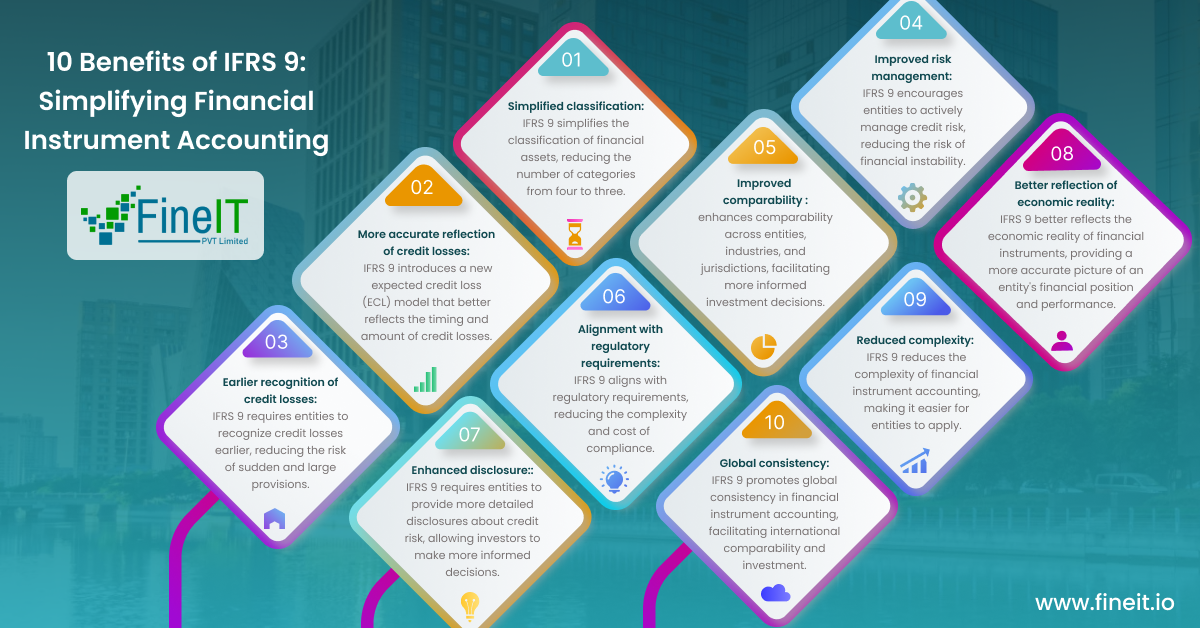
The International Financial Reporting Standard 9 (IFRS 9) has brought about significant changes in financial instrument accounting, offering numerous benefits to entities worldwide. Here are ten advantages of adopting IFRS 9:
1. How does IFRS 9 simplify the classification of financial instruments?
IFRS 9 streamlines the classification of financial assets, reducing categories from four to three, which simplifies accounting processes.
2. How does IFRS 9 enable more accurate measurement of credit losses?
With the introduction of the Expected Credit Loss (ECL) model, IFRS 9 provides a better reflection of the timing and amount of credit losses, enhancing accuracy in financial reporting.
3. Why does IFRS 9 require Why does IFRS 9 require earlier recognition of credit losses??:
Entities are now required to recognize credit losses earlier under IFRS 9, mitigating the risk of sudden and large provisions, and offering a more proactive approach to risk management.
4. How does IFRS 9 contribute to How does IFRS 9 support improved risk management practices??:
IFRS 9 encourages entities to actively manage credit risk, leading to better risk mitigation strategies and reduced financial instability.
5. What What enhanced disclosures does IFRS 9 require?s does IFRS 9 require?:
The standard mandates more detailed disclosures about credit risk, offering investors greater transparency and enabling them to make more informed investment decisions.
6. How does IFRS 9 align with regulatory requirements?:
IFRS 9 aligns with regulatory requirements, reducing complexity and costs associated with compliance efforts.
7. How does IFRS 9 improve the comparability of financial statements?:
By enhancing comparability across entities, industries, and jurisdictions, IFRS 9 facilitates better benchmarking and more informed investment decisions.
8. How does IFRS 9 reduce complexity in financial reporting?:
The standard simplifies financial instrument accounting, making it easier for entities to apply and reducing the burden of complex accounting rules.
9. How does IFRS 9 better reflect the economic reality of financial instruments?:
IFRS 9 offers a more accurate picture of an entity’s financial position and performance by better reflecting the economic reality of financial instruments.
10. How does IFRS 9 promote How does IFRS 9 promote global consistency in accounting standards? in accounting standards?:
Promoting global consistency in financial instrument accounting, IFRS 9 facilitates international comparability and investment, fostering a more integrated global financial system.
What is the overall What are the key takeaways from IFRS 9’s improvements? regarding IFRS 9’s impact?
In conclusion, the adoption of IFRS 9 brings about significant advantages for entities, including simplified processes, enhanced risk management, improved transparency, and global consistency, ultimately leading to better-informed decision-making and financial stability.
Frequently Asked Questions
About FineIT Private Limited
FineIT Private Limited is a leading Fintech provider.

Muzammal Rahim Khan is the CEO and Co-Founder of FineIT, bringing over 15 years of expertise in software development, implementation, and technical consulting across global markets including the U.S., U.K., Europe, Africa, and Asia. He has led the design and delivery of enterprise-grade solutions that modernize compliance, risk management, and financial reporting for banks and financial institutions. Under his leadership, FineIT has built flagship platforms such as Estimator9 (IFRS 9) and ContractHive (IFRS 16), empowering clients with automation, accuracy, and audit-ready confidence. Muzammal combines deep technical knowledge with strategic vision, driving innovation that bridges regulatory requirements with practical, scalable technology. His focus remains on building resilient, future-ready solutions that strengthen trust and efficiency in financial services.