
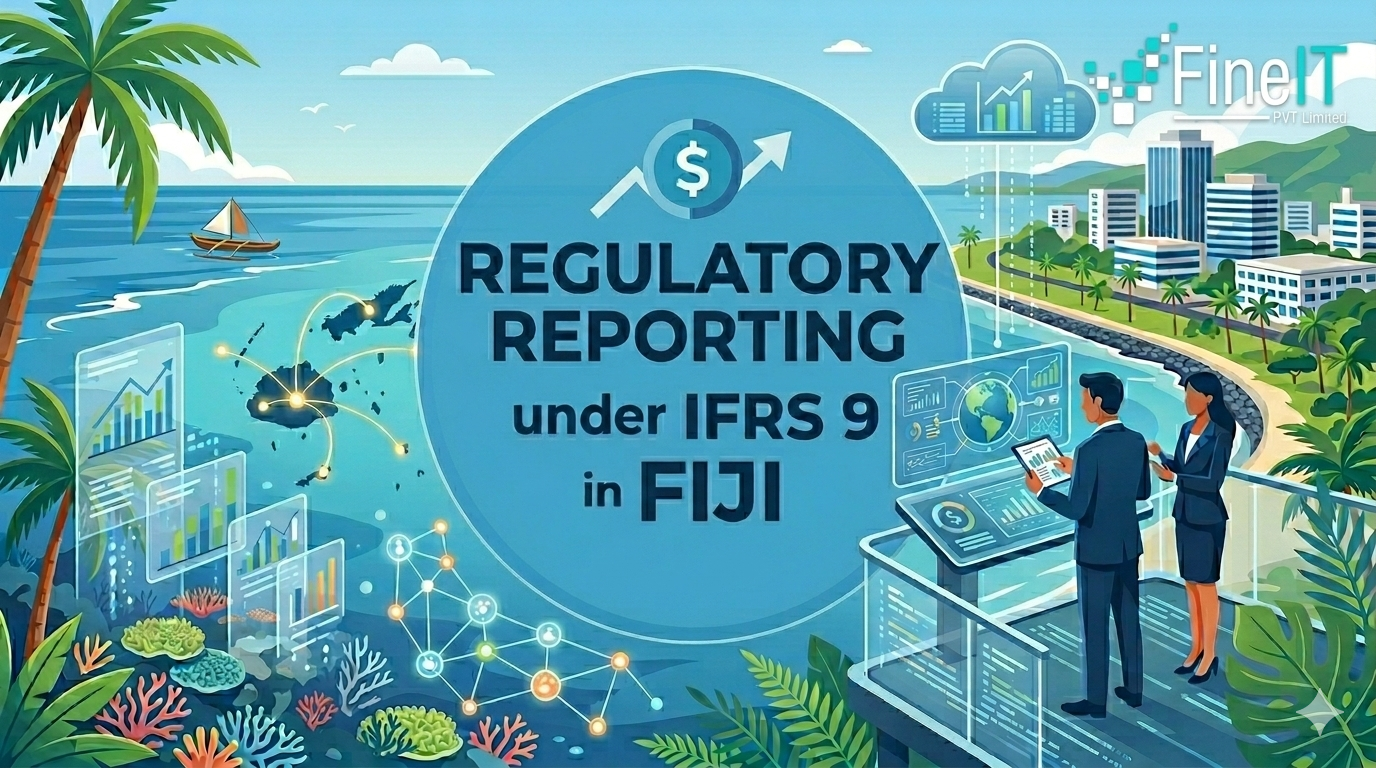
The landscape of financial reporting in Fiji underwent a seismic shift in 2018 with the mandatory adoption of IFRS 9 Financial Instruments. Replacing the older IAS 39, this standard redefined how the Fiji banking sector manages risk and communicates financial health to the Reserve Bank of Fiji (RBF).
In 2026, IFRS 9 is no longer just a “new rule”; it is the bedrock of Fiji’s financial stability, ensuring that institutions are prepared for the unique economic volatility of the Pacific.
1. The Core Pillar: From “Incurred” to “Expected” Loss
The most significant change under IFRS 9 is the Expected Credit Loss (ECL) model. Previously, banks only recognized a loss when a “trigger event” (like a default) occurred. Now, they must look forward.
Under the RBF’s supervision, loans are categorized into three stages:
Stage 1 (Performing):
No significant increase in credit risk; banks set aside a 12-month ECL.
Stage 2 (Under-performing):
Credit risk has increased significantly; banks must recognize a Lifetime ECL.
Stage 3 (Non-performing):
The loan is credit-impaired (default); Lifetime ECL is required.
2. Tailoring to the Fijian Context
Fiji’s regulatory reporting isn’t a carbon copy of global standards. The RBF ensures that ECL models reflect local realities:
Tourism Dependency:
Since tourism is a pillar of Fiji’s GDP, banks must incorporate forward-looking data on visitor arrivals. If a global downturn is predicted, provisions must increase immediately.
Climate & Natural Disaster Risk:
Fiji’s vulnerability to cyclones is now a financial data point. Banks often apply “overlays” to their ECL calculations during the cyclone season to account for potential agricultural or property damage.
Macroeconomic Data:
Reporting requires integration of local indicators like sugar prices, inflation rates, and GDP forecasts provided by the RBF.
3. Regulatory Compliance & Disclosures
The RBF enforces strict transparency through various Banking Supervision Policy Statements:
Policy Statement No. 3:
Provides the framework for loan classification and provisioning.
Policy Statement No. 5A/5B:
Mandates the publication of Key Disclosure Statements. Banks must display these in branches and publish them in the Fiji Republic Gazette, ensuring the public can assess the institution’s “Asset Quality” (impaired assets vs. total assets).
4. The Impact on Lending and Capital
This “prudent” reporting approach has real-world consequences:
Higher Reserves:
Because banks must provision for losses “on day one” of a loan, they hold more capital in reserve.
Stricter Credit Standards:
With risky loans requiring more capital, banks have become more selective, potentially impacting interest rates for higher-risk borrowers.
Conclusion
While IFRS 9 increased the complexity of regulatory reporting, it has made Fiji’s financial system more resilient. By recognizing risks before they materialize, Fijian banks are better equipped to handle the “rainy days” inherent in a Pacific island economy.
FineIT delivers tailored ECL modeling, regulatory reporting, and end-to-end implementation support aligned with the Reserve Bank of Fiji.
Connect with FineIT today to strengthen your IFRS 9 framework.

Muzammal Rahim Khan is the CEO and Co-Founder of FineIT, bringing over 15 years of expertise in software development, implementation, and technical consulting across global markets including the U.S., U.K., Europe, Africa, and Asia. He has led the design and delivery of enterprise-grade solutions that modernize compliance, risk management, and financial reporting for banks and financial institutions. Under his leadership, FineIT has built flagship platforms such as Estimator9 (IFRS 9) and ContractHive (IFRS 16), empowering clients with automation, accuracy, and audit-ready confidence. Muzammal combines deep technical knowledge with strategic vision, driving innovation that bridges regulatory requirements with practical, scalable technology. His focus remains on building resilient, future-ready solutions that strengthen trust and efficiency in financial services.