
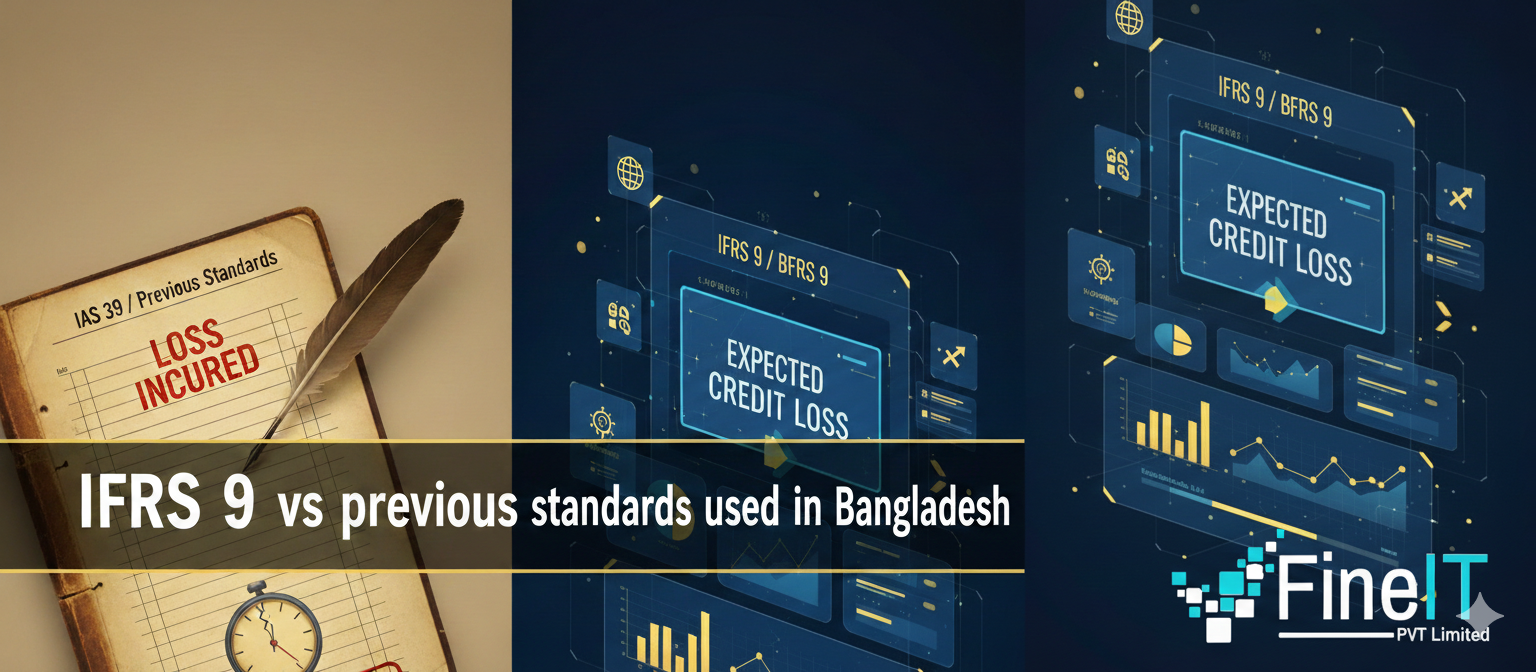
The landscape of financial reporting in Bangladesh is undergoing a significant transformation with the phased implementation of IFRS 9 (International Financial Reporting Standard 9), adopted locally as BFRS 9 (Bangladesh Financial Reporting Standard 9). This new standard is replacing the older IAS 39 (International Accounting Standard 39) and its local equivalents, marking a crucial shift, particularly for the country’s banking sector. The change moves away from a reactive “incurred loss” model to a more proactive “expected credit loss” approach, fundamentally altering how financial assets are classified, measured, and how provisions for potential losses are recognized.
The Shortcomings of the Previous Standards (IAS 39 / Local GAAP)
Under IAS 39 and the previous local accounting standards, financial institutions in Bangladesh operated on an “incurred loss” model. This meant that provisions for loan losses were only recognized when there was objective evidence that a loss event had already occurred. In essence, banks waited for a borrower to default, or for other clear signs of impairment (like missed payments or financial distress), before setting aside funds for potential losses.
While seemingly straightforward, this approach had several critical drawbacks:
“Too Little, Too Late”:
Losses were often recognized long after the underlying credit deterioration began. This delayed recognition meant that financial statements might not fully reflect the true risk exposure of a bank, especially during periods of economic downturn.
Procyclicality:
The incurred loss model tended to exacerbate economic cycles. During economic booms, credit flowed freely with minimal provisions, only for significant provisions to be required during downturns, further constraining lending when it was most needed.
Lack of Transparency:
The delayed recognition could obscure the actual health of a bank’s loan portfolio, making it difficult for investors, regulators, and other stakeholders to assess true risk.
Complexity in Classification:
IAS 39 had a complex set of rules for classifying financial instruments based on management’s intent (e.g., Held-to-Maturity, Available-for-Sale), which could lead to inconsistent application and potential for earnings management.
These limitations became particularly evident during global financial crises, where banks were perceived to be slow in recognizing losses, contributing to a lack of confidence in the financial system.
The Dawn of IFRS 9 / BFRS 9: A Forward-Looking Approach
IFRS 9, and by extension BFRS 9, introduces a paradigm shift with its Expected Credit Loss (ECL) model. This new approach requires financial institutions to anticipate potential future losses from the moment a financial instrument is originated or acquired, rather than waiting for an loss event to occur.
The core tenets of IFRS 9’s impact in Bangladesh include:
Expected Credit Loss (ECL) Model:
Forward-Looking:
Banks must estimate and recognize provisions for expected credit losses over the lifetime of a financial instrument, considering not just historical data but also current conditions and reasonable and supportable forward-looking information (e.g., macroeconomic forecasts like GDP growth, inflation rates, industry-specific trends).
Three-Stage Approach:
The ECL model operates on a three-stage impairment model:
Stage 1 (12-month ECL):
For financial instruments that have not experienced a significant increase in credit risk since initial recognition, banks recognize an expected credit loss for the next 12 months.
Stage 2 (Lifetime ECL):
If there has been a significant increase in credit risk since initial recognition, but the asset is not yet credit-impaired, banks must recognize lifetime expected credit losses.
Stage 3 (Lifetime ECL – Credit-Impaired):
For credit-impaired financial assets, banks continue to recognize lifetime expected credit losses, and interest revenue is calculated on the net carrying amount (gross carrying amount less impairment allowance).
Simplified Classification and Measurement:
IFRS 9 simplifies the classification of financial assets into three primary categories based on the entity’s business model for managing financial assets and the contractual cash flow characteristics of the asset (the “SPPI” test – Solely Payments of Principal and Interest):
Amortized Cost:
For assets held within a business model whose objective is to hold assets to collect contractual cash flows, and whose contractual terms give rise on specified dates to cash flows that are solely payments of principal and interest.
Fair Value Through Other Comprehensive Income (FVOCI):
For assets held within a business model whose objective is achieved by both collecting contractual cash flows and selling financial assets, and whose contractual terms also meet the SPPI test.
Fair Value Through Profit or Loss (FVTPL):
For all other financial assets.
Hedge Accounting:
IFRS 9 aligns hedge accounting more closely with risk management activities, providing more scope for entities to apply hedge accounting and reducing complexity compared to IAS 39.
Impact and Challenges for Bangladesh
The adoption of BFRS 9 is a significant undertaking for Bangladeshi financial institutions, particularly commercial banks. The Bangladesh Bank, the central bank, has been instrumental in guiding this transition. A notable directive is BRPD Circular No. 03 issued in January 2025, which outlines a phased implementation roadmap, targeting full adoption of the ECL-based loan classification and provisioning by December 2027.
Key impacts and challenges include:
Increased Provisions (“Day One Impact”):
Many banks will experience a “day one” increase in their loan loss provisions upon initial application of BFRS 9. This is because the ECL model requires immediate recognition of expected losses, moving provisions from the future to the present. This can affect a bank’s capital adequacy ratios.
Data Intensity:
The ECL model demands a vast amount of granular data, including historical default rates, recovery rates, and sophisticated macroeconomic forecasts. Many Bangladeshi banks need to significantly enhance their data collection, storage, and analytical capabilities.
Model Development:
Developing robust ECL models requires advanced statistical modeling expertise, which may be a new area for many institutions.
IT Infrastructure Upgrades:
To handle the increased data requirements and complex calculations, substantial investments in IT systems and software are necessary.
Skill Gaps:
There is a need to upskill existing personnel and hire new talent with expertise in areas like credit risk modeling, data analytics, and IFRS 9 interpretation.
Regulatory Alignment:
The Bangladesh Bank is actively working on aligning local prudential regulations with the requirements of BFRS 9, which requires ongoing coordination and guidance for banks.
Transparency and Stability:
In the long run, BFRS 9 is expected to enhance the transparency of financial statements, provide a more realistic view of credit risk, and contribute to the overall stability and resilience of the financial sector in Bangladesh.
Conclusion
The adoption of IFRS 9 (BFRS 9) represents a critical evolution from the reactive standards of the past to a modern, forward-looking financial framework. While the implementation path involves significant capital and technical hurdles, it ultimately strengthens the resilience of Bangladesh’s banking sector by ensuring that risks are recognized early and reported with greater transparency.
IFRS 9 is reshaping credit risk management in Bangladesh.
Partner with Fineit to turn regulatory requirements into sustainable financial resilience.

Muzammal Rahim Khan is the CEO and Co-Founder of FineIT, bringing over 15 years of expertise in software development, implementation, and technical consulting across global markets including the U.S., U.K., Europe, Africa, and Asia. He has led the design and delivery of enterprise-grade solutions that modernize compliance, risk management, and financial reporting for banks and financial institutions. Under his leadership, FineIT has built flagship platforms such as Estimator9 (IFRS 9) and ContractHive (IFRS 16), empowering clients with automation, accuracy, and audit-ready confidence. Muzammal combines deep technical knowledge with strategic vision, driving innovation that bridges regulatory requirements with practical, scalable technology. His focus remains on building resilient, future-ready solutions that strengthen trust and efficiency in financial services.