
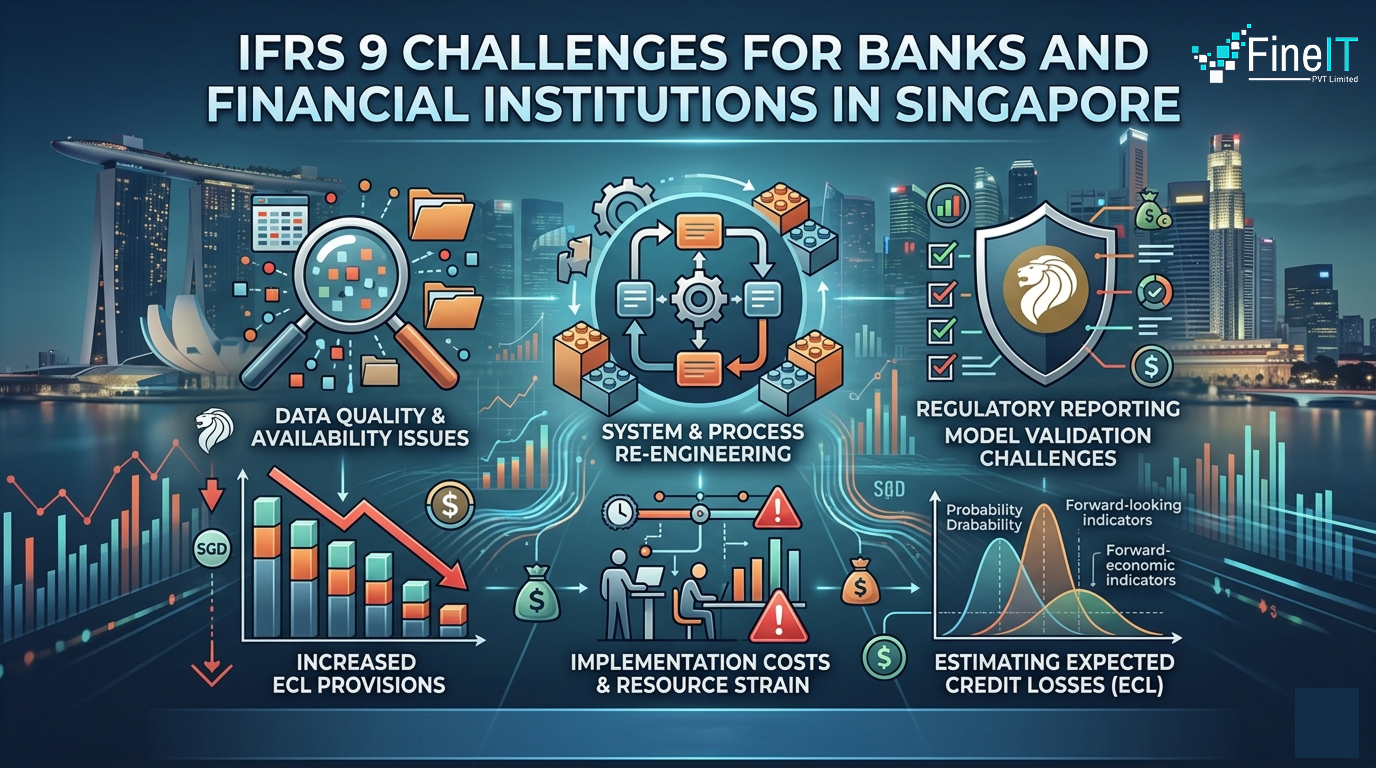
The implementation of IFRS 9 Financial Instruments (adopted in Singapore as SFRS(I) 9) has fundamentally reshaped the financial reporting landscape for banks and financial institutions (FIs). While the standard has been in effect for several years, evolving market conditions, stricter regulatory scrutiny from the Monetary Authority of Singapore (MAS), and rapid technological shifts continue to present significant operational and strategic hurdles.
As of 2026, Singaporean FIs are moving beyond “Day 1” compliance and are now grappling with deep-seated challenges in model sustainability, data integration, and the alignment of accounting with risk management.
1. What is What is the Forward-Looking ECL Paradox??
The core of IFRS 9 is the Expected Credit Loss (ECL) model. Unlike the old “incurred loss” model, ECL requires banks to recognize losses before they occur, based on forward-looking macroeconomic forecasts.
How does How does macroeconomic volatility affect IFRS 9 compliance? impact IFRS 9 compliance?:
In a volatile global economy, predicting factors like GDP growth, unemployment rates, and property price indices in Singapore is increasingly difficult. Small shifts in these forecasts can lead to massive “cliffs” in provisioning, causing significant volatility in a bank’s profit and loss (P&L) statement.
The “Significant Increase in Credit Risk” (SICR) Threshold:
Determining exactly when an asset moves from “Stage 1” (12-month ECL) to “Stage 2” (Lifetime ECL) remains a subjective exercise. MAS expects banks to have robust, evidence-based triggers, but the lack of historical data for “black swan” events makes these thresholds hard to calibrate.
2. How can banks ensure How can banks ensure data integrity and granularity??
IFRS 9 is data-hungry. To feed ECL models and satisfy MAS 610/1003 reporting requirements, banks must collect more granular data than ever before.
What What legacy system constraints challenge IFRS 9 implementation? hinder IFRS 9 implementation?:
Many older banking systems were not designed to track the life-cycle data required for IFRS 9, such as original credit ratings or historical repayment patterns at the individual loan level.
Why is Why is data reconciliation critical for IFRS 9? critical for IFRS 9 compliance?:
Ensuring that the data used by the Risk department for Basel capital requirements matches the data used by Finance for IFRS 9 reporting is a constant struggle. Discrepancies can lead to regulatory red flags and audit complications.
3. What are the challenges in classification and measurement under the SPPI Test?
Under IFRS 9, financial assets must pass the Solely Payments of Principal and Interest (SPPI) test to be measured at amortized cost.
How should banks classify complex financial products under IFRS 9?:
Singapore’s status as a financial hub means its FIs deal with complex, structured products. Any “exotic” feature—such as leverage, certain convertible options, or ESG-linked interest rate adjustments—can cause a loan to fail the SPPI test.
What causes What causes FVTPL volatility and how can it be managed? in IFRS 9 reporting?:
If an asset fails the SPPI test, it must be measured at Fair Value Through Profit or Loss (FVTPL). This forces banks to market-to-market loans that were previously held at cost, introducing further volatility into their earnings.
4. Why does IFRS 9 implementation face Why is regulatory and audit scrutiny a critical concern??
In 2025 and 2026, the Accounting and Corporate Regulatory Authority (ACRA) and MAS have intensified their focus on the “connectivity” between sustainability disclosures and financial reporting.
How should climate risk be integrated into IFRS 9 models?:
There is a growing expectation for banks to incorporate environmental risks into their ECL models. For instance, how does a “carbon tax” impact the probability of default for a corporate borrower in the shipping or energy sector?
What are best practices for IFRS 9 What are the best practices for IFRS 9 model validation??:
Regulators now require more frequent and rigorous independent validation of ECL models. Banks must prove that their models aren’t just “black boxes” but are transparent, explainable, and stress-tested against multiple scenarios.
5. What How do resource and talent constraints impact IFRS 9 implementation? do banks face with IFRS 9?
The “IFRS 9 ecosystem” requires a rare blend of expertise in accounting, quantitative modeling, and IT.
How does How does the talent war impact IFRS 9 implementation? affect IFRS 9 implementation?:
In Singapore’s competitive fintech and banking landscape, finding professionals who understand both the technical nuances of IFRS 9 and the local regulatory environment is a major challenge.
What is the true cost of IFRS 9 compliance for banks?:
For smaller wholesale banks or non-bank financial institutions in Singapore, the ongoing cost of maintaining sophisticated ECL engines and specialized teams can be disproportionately high.
What are the key takeaways for IFRS 9 implementation?
IFRS 9 is no longer just an accounting change; it is a fundamental shift in how Singaporean banks manage risk and capital. To thrive, institutions must move away from manual “workarounds” and invest in RegTech solutions that automate data flows and provide real-time visibility into credit risk.
Navigating IFRS 9 (SFRS(I) 9) challenges doesn’t have to be complex. With increasing expectations from Monetary Authority of Singapore and Accounting and Corporate Regulatory Authority, having the right technology partner is critical.
FineIT empowers financial institutions in Singapore with automated, audit-ready ECL solutions—ensuring compliance, accuracy, and scalability.
👉 Explore more: https://fineit.io
🚀 Book a Demo: https://fineit.io/request-demo
Frequently Asked Questions
About FineIT Private Limited
FineIT Private Limited is a leading Fintech provider.

Muzammal Rahim Khan is the CEO and Co-Founder of FineIT, bringing over 15 years of expertise in software development, implementation, and technical consulting across global markets including the U.S., U.K., Europe, Africa, and Asia. He has led the design and delivery of enterprise-grade solutions that modernize compliance, risk management, and financial reporting for banks and financial institutions. Under his leadership, FineIT has built flagship platforms such as Estimator9 (IFRS 9) and ContractHive (IFRS 16), empowering clients with automation, accuracy, and audit-ready confidence. Muzammal combines deep technical knowledge with strategic vision, driving innovation that bridges regulatory requirements with practical, scalable technology. His focus remains on building resilient, future-ready solutions that strengthen trust and efficiency in financial services.