
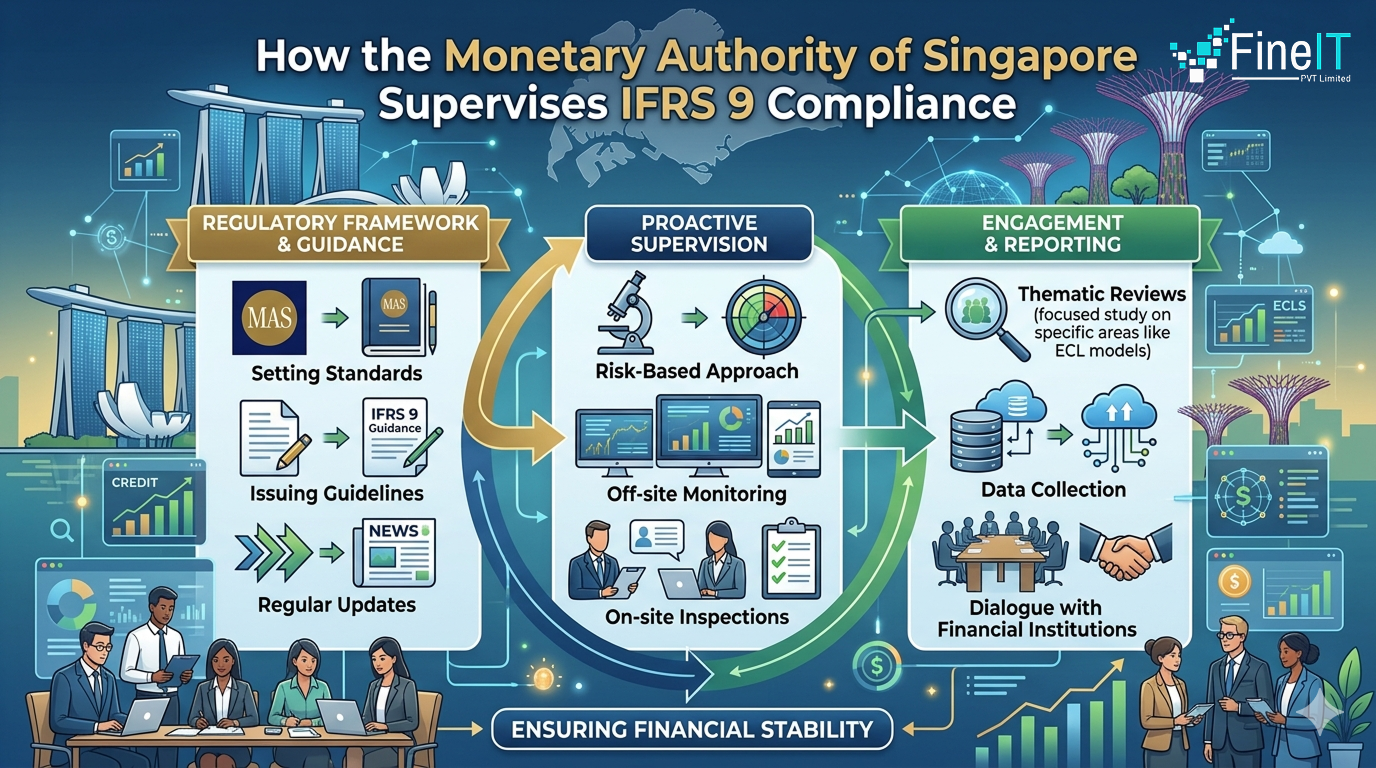
In the wake of the global shift toward more resilient accounting standards, the Monetary Authority of Singapore (MAS) has established itself as a rigorous overseer of IFRS 9 (SFRS(I) 9). This standard, which centers on the Expected Credit Loss (ECL) model, requires financial institutions to look into the future rather than the past. For MAS, supervising this transition is not merely about checking boxes; it is about ensuring the entire Singaporean financial ecosystem can withstand “black swan” events before they occur.
1. What is the foundation of MAS Notice 612?
The primary instrument of supervision is MAS Notice 612 (Credit Files, Grading and Provisioning). While IFRS 9 provides the global “what,” Notice 612 provides the Singaporean “how.”
What are What are prudential overlays??:
MAS requires banks to maintain a Regulatory Loss Allowance Reserve (RLAR). If the ECL calculated under IFRS 9 is lower than the MAS-mandated prudential floor, banks must set aside additional capital.
What is How is standardized grading implemented??:
MAS enforces a strict credit grading system (Pass, Special Mention, Substandard, Doubtful, and Loss). This ensures that all banks speak the same “risk language” when classifying assets into IFRS 9’s three stages.
2. Advanced Data Analytics and “Off-Site” Monitoring
MAS utilizes a data-driven approach to monitor compliance in real-time. By leveraging the Notice 610 reporting framework, MAS collects granular data on loan portfolios.
How does Why is benchmarking important? apply?:
MAS uses automated tools to compare ECL coverage ratios across peer banks. If a bank’s provisions are significantly lower than the industry average for similar risks, it triggers a supervisory inquiry.
What is What is macro-scenario analysis??:
MAS scrutinizes the “Forward-Looking Information” (FLI) that banks use. If a bank’s internal economic forecasts are inconsistent with MAS’s own macroeconomic outlook for Singapore and the region, the bank must justify its stance.
3. What are thematic reviews and how do they examine model integrity?
Periodically, MAS conducts Thematic Reviews—targeted investigations into specific areas of IFRS 9 implementation across the entire banking sector.
How is What are the requirements for model validation? conducted?:
Supervisors examine the “back-testing” of ECL models to see if they accurately predicted past defaults.
What are How do management overlays affect compliance??:
During times of high uncertainty (like the 2024–2025 inflationary period), banks often apply manual “overlays” to their model outputs. MAS reviews these to ensure they are transparent, governed by a committee, and not used for “earnings management” (artificially smoothing profits).
4. What do on-site inspections reveal about governance?
The most direct form of supervision is the On-Site Inspection. MAS inspectors visit banks to:
Why Why is interviewing key personnel necessary??:
They speak with Chief Risk Officers and heads of model validation to assess the “culture of compliance.”
How do you What is involved in auditing data lineage??:
They trace data from the original loan contract all the way to the final ECL calculation in the financial statement to ensure no “data leakage” or errors occur.
What are the key takeaways?:
The Monetary Authority of Singapore’s supervision of IFRS 9 is characterized by its proactive and data-centric nature. By combining the strict mandates of Notice 612 with sophisticated thematic reviews and real-time data monitoring, MAS ensures that “Expected Credit Losses” are not just theoretical numbers, but accurate reflections of risk.
As we move through 2026, this level of oversight remains a cornerstone of Singapore’s reputation as a safe, transparent, and resilient global financial hub. For institutions, the message is clear: compliance is not a static destination, but a continuous journey of data integrity and rigorous governance.
Preparing for IFRS 9 compliance in Singapore? FineIT provides advanced Expected Credit Loss (ECL) software and consulting to help banks meet regulatory expectations from the Monetary Authority of Singapore.
Contact us today to streamline your IFRS 9 implementation and stay audit-ready.
Frequently Asked Questions
About FineIT Private Limited
FineIT Private Limited is a leading Fintech provider.

Muzammal Rahim Khan is the CEO and Co-Founder of FineIT, bringing over 15 years of expertise in software development, implementation, and technical consulting across global markets including the U.S., U.K., Europe, Africa, and Asia. He has led the design and delivery of enterprise-grade solutions that modernize compliance, risk management, and financial reporting for banks and financial institutions. Under his leadership, FineIT has built flagship platforms such as Estimator9 (IFRS 9) and ContractHive (IFRS 16), empowering clients with automation, accuracy, and audit-ready confidence. Muzammal combines deep technical knowledge with strategic vision, driving innovation that bridges regulatory requirements with practical, scalable technology. His focus remains on building resilient, future-ready solutions that strengthen trust and efficiency in financial services.