
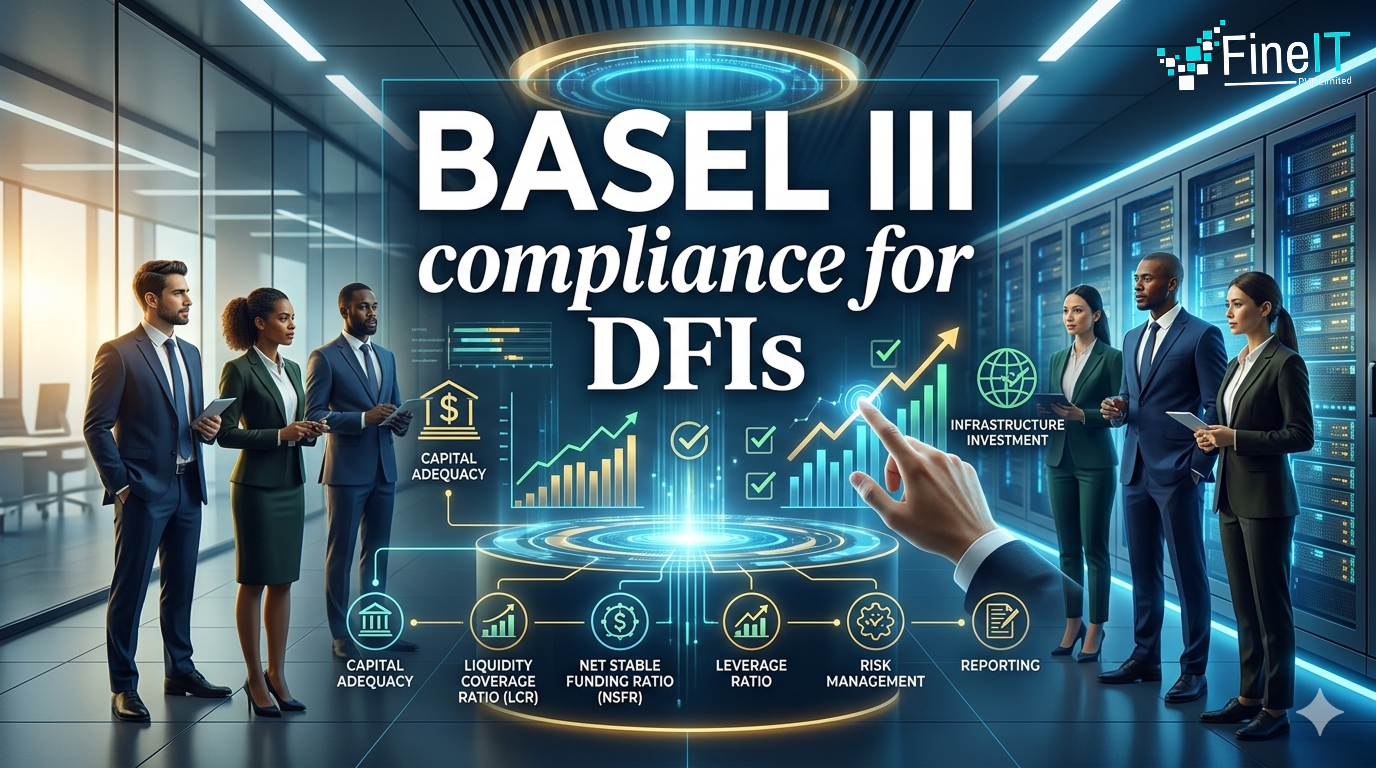
The implementation of Basel III standards represents a seismic shift for Development Finance Institutions (DFIs). Traditionally viewed as specialized vehicles for long-term economic growth rather than profit-seeking commercial entities, DFIs now face a regulatory landscape that demands the same rigor and transparency as the world’s largest commercial banks.
1. The Core Pillars of Basel III for DFIs
Basel III is built on three distinct pillars, each posing unique operational challenges for development banks.
Pillar 1: Minimum Capital Requirements
DFIs must maintain higher quality capital, primarily Common Equity Tier 1 (CET1). While many DFIs are well-capitalized by their sovereign owners, the “risk-weighting” of their assets is a point of contention. For example, infrastructure projects in emerging markets often carry a high risk weight ($130\%$ or more), which can limit a DFI’s capacity to lend unless they hold massive capital buffers.
Pillar 2: Supervisory Review Process
This requires DFIs to conduct an Internal Capital Adequacy Assessment Process (ICAAP). It forces institutions to look beyond standard formulas and assess “tail risks,” such as political instability or climate-related shocks to their portfolios.
Pillar 3: Market Discipline
Transparency is the goal here. DFIs must provide detailed public disclosures regarding their risk management, capital structure, and liquidity. This is often a cultural shift for state-owned institutions that historically operated with less public scrutiny.
2. The Liquidity Challenge: LCR and NSFR
One of the most difficult hurdles for DFIs is the Basel III liquidity framework, which was designed for banks that take short-term deposits—something many DFIs do not do.
| Metric | Definition | DFI Challenge |
| Liquidity Coverage Ratio (LCR) | Ensures a bank has enough high-quality liquid assets (HQLA) to survive a 30-day stress scenario. | DFIs often operate in markets where “high-quality” assets (like liquid government bonds) are scarce. |
| Net Stable Funding Ratio (NSFR) | Requires a reliable amount of stable funding over a one-year horizon. | Since DFIs fund long-term projects (10–20 years), matching this with stable, long-term funding sources can be expensive. |
3. The “Proportionality” Debate
A significant tension exists between financial stability and development mandates.
The Conflict:
Strict Basel III compliance can lead to “prudence paralysis.” If a DFI is forced to hold too much capital against a “risky” green energy project in a developing nation, it may choose not to fund the project at all, directly contradicting its mission.
The Solution:
Many regulators are advocating for proportionality—applying Basel III in a way that recognizes the specific risk profile of DFIs. This includes recognizing the “preferred creditor status” of multilateral DFIs, which historically makes their loans much safer than commercial ones.
4. Strategic Benefits of Compliance
Despite the hurdles, becoming Basel III compliant offers DFIs several long-term advantages:
Lower Cost of Funding:
Compliance signals to international capital markets that the DFI is “safe,” often leading to better credit ratings and cheaper borrowing costs on bond markets.
Crowding-In Private Capital:
When a DFI follows international standards, it is easier for private commercial banks to co-finance projects, as they are speaking the same “regulatory language.”
Resilience to Crises:
The 2008 and 2020 economic shocks proved that institutions with robust capital and liquidity buffers are much more likely to survive systemic volatility.
5. Future Outlook: Basel III and Climate Finance
As we move toward 2026, the discussion is shifting toward how Basel III can be “recalibrated” for the climate transition. There is a growing push to allow lower risk weights for sustainable infrastructure, allowing DFIs to deploy more capital toward net-zero goals without breaching their regulatory requirements.
Ready to turn Basel III complexity into a strategic advantage?
With FineIT, DFIs can seamlessly align capital, liquidity, and risk frameworks—while continuing to fund impactful development projects with confidence.
👉 Take control of compliance without compromising your mission—explore FineIT today:
FineIT Link: https://fineit.io/
Demo Link: https://fineit.io/request-demo

Muzammal Rahim Khan is the CEO and Co-Founder of FineIT, bringing over 15 years of expertise in software development, implementation, and technical consulting across global markets including the U.S., U.K., Europe, Africa, and Asia. He has led the design and delivery of enterprise-grade solutions that modernize compliance, risk management, and financial reporting for banks and financial institutions. Under his leadership, FineIT has built flagship platforms such as Estimator9 (IFRS 9) and ContractHive (IFRS 16), empowering clients with automation, accuracy, and audit-ready confidence. Muzammal combines deep technical knowledge with strategic vision, driving innovation that bridges regulatory requirements with practical, scalable technology. His focus remains on building resilient, future-ready solutions that strengthen trust and efficiency in financial services.